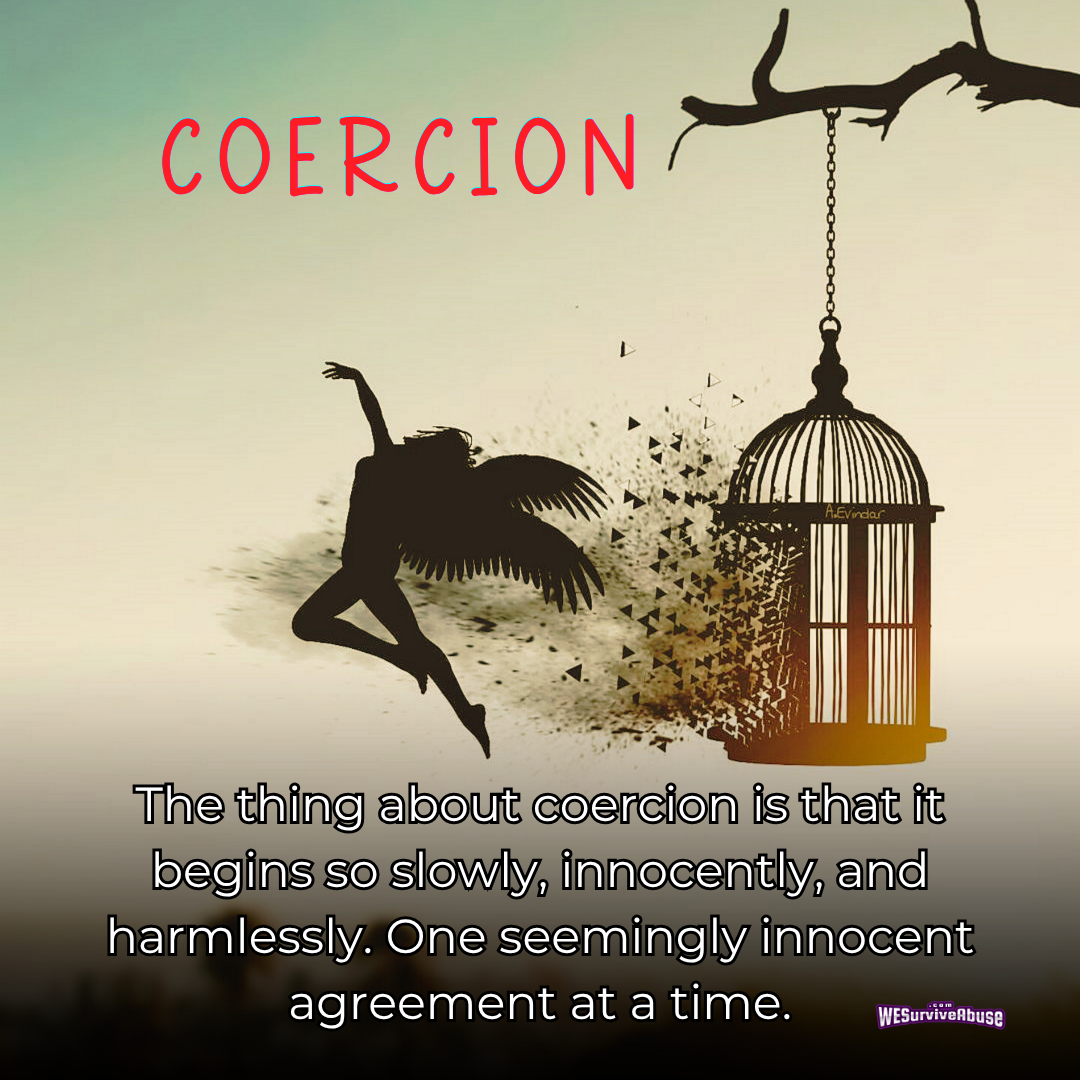
Coercion is the use of pressure, threats, intimidation, manipulation, or force to make someone do something they do not freely want to do. The key issue is that the person’s ability to make a genuine, voluntary choice is undermined.
In abusive relationships, coercion often becomes part of a broader pattern called coercive control, where one person seeks to dominate and control another person’s behavior, decisions, relationships, finances, beliefs, or daily life.
Examples of Coercion
A person may be coercive if they:
- Threaten to harm you, themselves, your children, pets, or loved ones if you do not comply.
- Use intimidation, yelling, destruction of property, or displays of anger to make you submit.
- Isolate you from friends, family, church, or support networks.
- Control access to money, transportation, phones, or important documents.
- Constantly monitor your whereabouts, communications, or activities.
- Manipulate you with guilt, shame, or accusations until you give in.
- Pressure you into sexual activity after you’ve said no.
- Use religious teachings to demand unquestioning obedience or silence.
- Threaten divorce, abandonment, public humiliation, or loss of custody to force compliance.
For example, if a husband says, “If you tell anyone what’s happening in our home, I’ll make sure the children are taken from you,” that is coercion. The wife’s choices are being controlled through fear.
Coercion and Consent
A person may technically say “yes” while not freely consenting.
If someone agrees because they fear consequences, punishment, retaliation, violence, or emotional devastation, that agreement is not truly free.
This is why coercion is so serious. It attacks a person’s agency and dignity.
What Does Scripture Say?
The Bible presents godly leadership and love as the opposite of coercion.
Jesus said:
“Whoever wants to be a leader among you must be your servant.”
— Matthew 20:26 (NLT)
And husbands are commanded:
“Love your wives, just as Christ loved the church. He gave up his life for her.”
— Ephesians 5:25 (NLT)
Christ leads through sacrificial love, truth, patience, and service—not through intimidation, threats, fear, or control.
When someone uses fear to dominate another person, they are not reflecting Christ’s example.
Questions to Consider
If you’re wondering whether something is coercion, ask:
- Am I free to disagree without being punished?
- Can I say no without fearing retaliation?
- Do I feel pressured into choices I would not otherwise make?
- Are threats, intimidation, guilt, or fear being used to gain compliance?
- Do I feel like I’m constantly managing someone’s reactions to stay safe?
If the answer to several of these questions is yes, coercion may be present.
Scripture consistently condemns the kinds of behaviors that coercion involves: oppression, intimidation, exploitation, manipulation, threats, and the misuse of power.
God created human beings in His image with real moral agency. Throughout Scripture, He calls people to respond to Him willingly rather than through human force or domination.
God Opposes Oppression
One of the clearest biblical themes is God’s concern for those who are oppressed by the powerful.
“The LORD is a refuge for the oppressed, a stronghold in times of trouble.”
— Psalm 9:9
“Learn to do good. Seek justice. Help the oppressed.”
— Isaiah 1:17 (NLT)
When someone uses fear, threats, or control to dominate another person, they are acting in a way that God repeatedly condemns.
God Condemns the Misuse of Power
Jesus contrasted worldly leadership with godly leadership:
“You know that the rulers in this world lord it over their people, and officials flaunt their authority over those under them. But among you it will be different.”
— Matthew 20:25–26 (NLT)
The phrase “lord it over” refers to using power to dominate others. Jesus explicitly rejects this model for His followers.
Christian leadership—whether in marriage, family, church, or elsewhere—is meant to be characterized by service, humility, and love, not control and intimidation.
God’s Love Does Not Coerce
God Himself, though all-powerful, does not model coercive relationships. He invites, calls, warns, teaches, and persuades, but He does not force genuine love.
Throughout Scripture, God’s desire is for willing devotion:
“Love the LORD your God with all your heart, all your soul, and all your strength.”
— Deuteronomy 6:5 (NLT)
Love that is compelled by threats is not love. In healthy human relationships, love likewise cannot be manufactured through fear or domination.
Husbands Are Called to Sacrificial Love, Not Control
In discussions of marriage, some abusive people misuse passages about submission to justify coercion. But when we read the whole passage, the husband’s command is not to control but to love.
“For husbands, this means love your wives, just as Christ loved the church. He gave up his life for her.”
— Ephesians 5:25 (NLT)
Christ’s love protects, serves, nurtures, and sacrifices. It does not intimidate, threaten, manipulate, or coerce.
A husband demanding obedience through fear is not following Christ’s example.
God Values Truth
Coercion often relies on deception, gaslighting, intimidation, or manipulation. Scripture repeatedly teaches that God delights in truth.
“The LORD detests lying lips, but he delights in those who tell the truth.”
— Proverbs 12:22 (NLT)
Healthy relationships can withstand honesty and disagreement. Coercive relationships often cannot.
The Fruit of the Spirit Contradicts Coercion
Paul describes the character produced by God’s Spirit:
“Love, joy, peace, patience, kindness, goodness, faithfulness, gentleness, and self-control.”
— Galatians 5:22–23 (NLT)
Notice what is absent: intimidation, domination, threats, manipulation, and control.
Coercion is often rooted in a desire to control others. The fruit of the Spirit begins with self-control.
What This Means Practically
If someone says:
- “God wants you to obey me no matter what.”
- “If you were a better Christian, you wouldn’t question me.”
- “God hates divorce, so you must stay no matter how I treat you.”
- “Submitting means doing whatever I say.”
those statements may be attempts to use spiritual authority coercively.
Scripture never gives anyone unlimited authority over another person. Every human authority is accountable to God and is called to exercise power in ways that reflect His character.
A Word for Those Experiencing Coercion
If someone is using fear, threats, intimidation, manipulation, or spiritual pressure to control you, remember:
God is not the author of that coercion.
God sees what is happening.
God cares about your safety and dignity.
God’s heart is for the oppressed, not for oppression.
As Psalm 9:9 reminds us:
“The LORD is a refuge for the oppressed, a stronghold in times of trouble.”
The God revealed in Scripture is not a partner with coercion. He is a refuge from it, a defender against it, and a source of wisdom, courage, and protection for those who suffer under it.