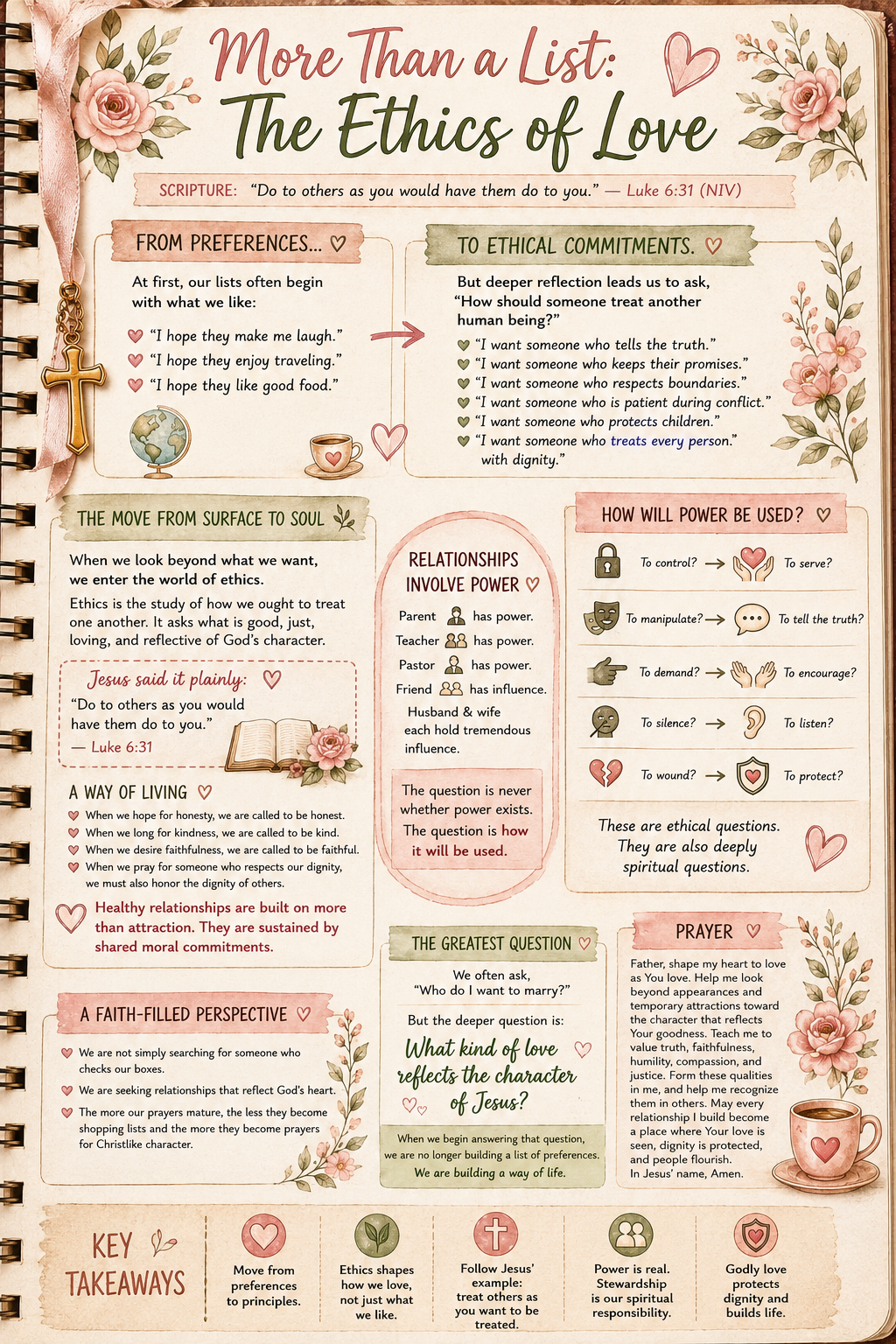
Scripture: “Do to others as you would have them do to you.” — Luke 6:31 (NIV)
Many people have been encouraged to make a list of what they hope for in a future spouse.
Now at first, those lists often begin with preferences.
“I hope they make me laugh.”
“I hope they enjoy traveling.”
“I hope they like good food.”
There is nothing wrong with those things. It’s pretty normal. God created us with personalities, interests, and unique ways of connecting with one another.
But if we keep reflecting, if we go a bit deeper, something beautiful often begins to happen.
The list changes.
Instead of asking, “What do I like?” we begin asking, “How should someone treat another human being?” And not just me. Because it isn’t that difficult to show praise and admiration for someone you admire. But how do they treat me and others too.
Now…..the conversation becomes deeper. This is good. We want to reflect deeply on the people we will spend our time with. We want to reflect deeply on how we want to be treated.
“I want someone who tells the truth.”
“I want someone who keeps their promises.”
“I want someone who respects boundaries.“
“I want someone who is patient during conflict.”
“I want someone who protects children.”
“I want someone who treats every person with dignity.”
Without realizing it, we have moved beyond preferences.
We have entered the world of ethics.
Ethics is simply the study of how we ought to treat one another. It asks what is good, what is just, what is loving, and what reflects the character of God.
These days, people resist that kind of talk, but we see where that has gotten us. Nowhere good. Some people like to keep “goodness” and “justice” vague because it serves their purposes.
Jesus did not leave us wondering.
He said,
“Do to others as you would have them do to you.”
That is not merely relationship advice.
It is an ethical way of living.
When we hope for honesty, we are also called to become honest.
When we long for kindness, we are called to practice kindness.
When we desire faithfulness, we are invited to become faithful.
When we pray for someone who respects our dignity, we must also become people who honor the dignity of others.
Healthy relationships are built on more than attraction. They are sustained by shared moral commitments.
Every close relationship involves power.
A parent has power.
A teacher has power.
A pastor has power.
A friend has influence.
A husband and wife each hold tremendous influence on one another’s lives.
The question is never whether power exists. The question is how it will be used.
Will it be used to control or to serve?
To manipulate or to tell the truth?
To demand or to encourage?
To silence or to listen?
To wound or to protect?
These are ethical questions.
They are also deeply spiritual questions.
As followers of Christ, we are not simply searching for someone who checks our boxes. We are seeking relationships that reflect God’s heart.
The more our prayers mature, the less they become shopping lists and the more they become prayers for Christlike character.
Perhaps the greatest relationship question is not, “Who do I want to marry?”
Perhaps it is this:
What kind of love reflects the character of Jesus?
When we begin answering that question, we are no longer building a list of preferences.
We are building a way of life.
Prayer
Father, shape my heart to love as You love. Help me look beyond appearances and temporary attractions toward the character that reflects Your goodness. Teach me to value truth, faithfulness, humility, compassion, and justice. Form these qualities in me, and help me recognize them in others. May every relationship I build become a place where Your love is seen, dignity is protected, and people flourish. In Jesus’ name, Amen.