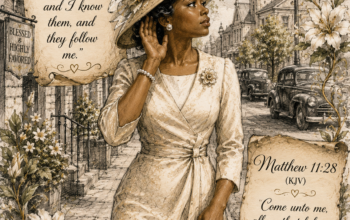
There is a truth we need to hold with both hands.
Some girls have been harmed in church spaces. Some were silenced there. Some were told to forgive before anyone made them safe. Some watched adults protect a name, a pulpit, a family, a ministry, or a reputation before they protected a child.
That truth deserves a witness.
And there is another truth standing beside it.
For many little Black girls, the church has also been refuge.
Church was the place where somebody noticed her. Church was where an elder woman looked past the smile and saw the tiredness in her eyes. Church was where a Sunday school teacher said, “Baby, you are more than what they called you.” Reminded her that Jesus endured taunting, ridicule, and outcasting too.
Church was where she learned to sing before she learned to shrink. Church was where she got a meal, a ride, a clean dress, a notebook, a word of prayer, a little courage, and sometimes the first adult who believed she had a future.
That refuge matters because Black girls are growing up against storms many people still refuse to name.
Black girls face racism and sexism together. They are often treated as older than they are, stronger than they are, and less in need of gentleness than they are. In schools, they are punished more harshly. In public, they are watched more closely. In families, they may be expected to carry adult emotions too early. In the world, they are often told to be excellent, polite, resilient, careful, modest, forgiving, ambitious, spiritual, and silent all at once.
That is too much weight for a child.
“Just be a good person” is too thin for the roads Black girls may have to travel.
Goodness is beautiful, but goodness alone does not teach a girl how to recognize manipulation. It does not teach her how to name disrespect. It does not teach her how to survive rejection, racism, sexism, grief, jealousy, poverty, danger, pressure, or predatory attention. It does not teach her how to guard her spirit when the world rewards her labor but resents her confidence.
Black girls need tools.
They need language. They need discernment. They need prayer and practice. They need safe adults. They need boundaries. They need stories of women who survived hard seasons without surrendering their souls. They need spaces where their girlhood is protected, their gifts are cultivated, and their questions are welcomed.
At its best, the Black church has known how to do this.
The Black church has never been only a Sunday morning building. At its best, it has been a school of courage. A place of memory. A shelter in hostile weather. A community bulletin board. A food pantry. A choir stand. A scholarship fund. A funeral home for our grief and a launching pad for our dreams.
For little Black girls, the best church spaces gave more than rules. They gave wings.
They taught her that she came from people who prayed through danger, organized under pressure, sang through sorrow, and still built something beautiful. They taught her that God saw her before the world stereotyped her. They taught her that her voice was not an accident. They taught her that dignity was not something she had to beg for.
This is why the answer cannot be to throw Black girls into a world with slogans and no shelter.
Online voices may rightly name harm in religious spaces. Harm should be named. Coverups should be confronted. Predators should never be protected by titles, robes, donations, popularity, or family loyalty. A church that cannot protect children has lost its moral footing.
But critique alone does not raise a girl.
If people are going to tell Black girls where they should not go, they also need to help build places where Black girls can breathe, learn, grow, question, worship, heal, and prepare for life. It is easy to point at broken rooms. It is harder to build safe ones.
The Black church has a sacred opportunity right now.
It can become more honest and more protective. It can keep the refuge and remove the silence. It can teach faith without fear. It can teach modesty without shame. It can teach forgiveness without forcing girls back into danger. It can teach obedience to God without training children to obey unsafe adults. It can honor elders while still listening to children. It can believe survivors without abandoning due process. It can make child safety a ministry, not a side note.
Black girls need more than applause when they perform. They need protection when they are vulnerable.
They need adults who understand that racism and sexism are real forces, not excuses. They need adults who know that every loud girl is not defiant, every quiet girl is not fine, every strong girl is not safe, and every gifted girl is not grown.
The church can meet these needs when it chooses courage over image.
A safe Black church can teach a girl how to pray and how to say no. How to forgive and how to leave. How to honor God and how to honor her own warning signals. How to serve without becoming a sacrifice. How to love people without handing them the keys to her whole life.
That kind of church is not outdated.
That kind of church is necessary.
Because a Black girl does not need a world that merely tells her to be nice. To: “Be a good person.” She needs a village that teaches her how to be wise, rooted, protected, creative, brave, and free. She needs a refuge, a sanctuary, and a community that helps her over the rocky parts of the journey.
When the Black church gets this right, it does not just help girls survive Sunday.
It helps them walk through every hard season with wings.