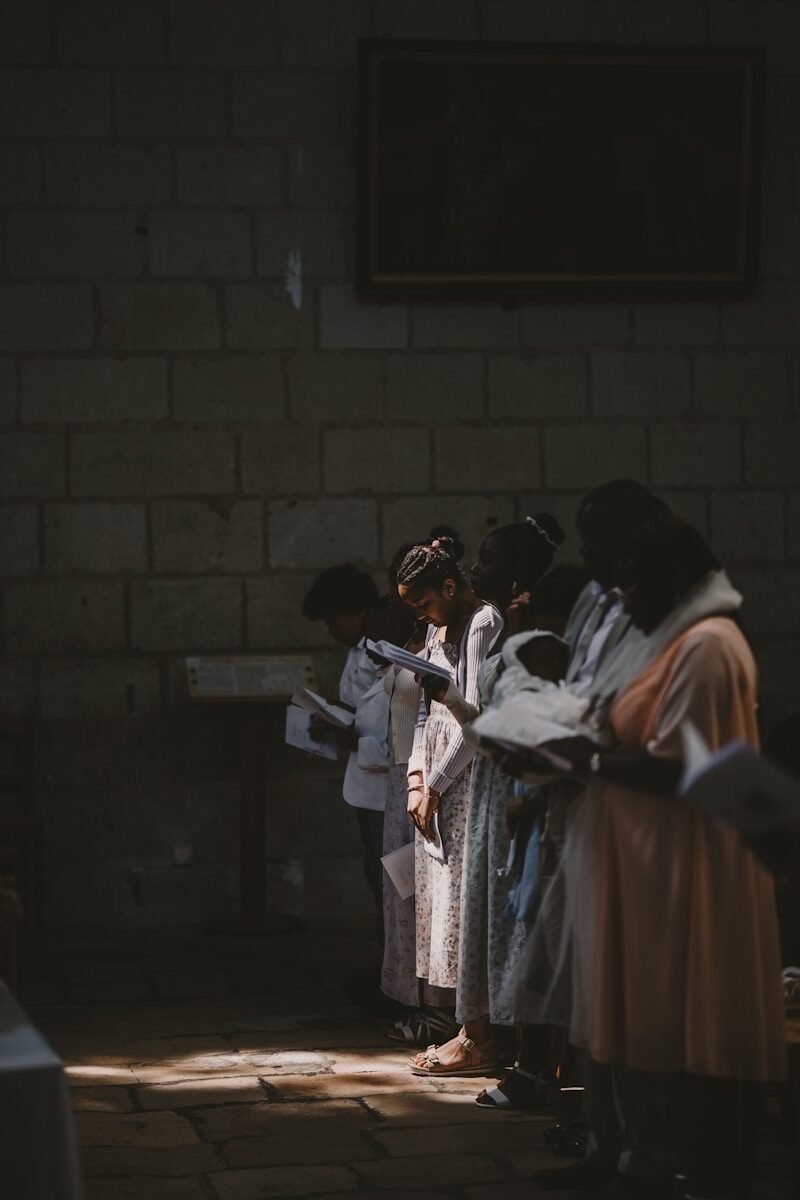
There is a kind of love that protects, and there is a kind of pressure that wears love’s clothing. Children cannot always tell the difference. That is not their failure — it is their nature. They are built to trust the adults around them, built to want belonging, built to believe that if a grown-up or a group says “this is how you prove you’re good,” then doing it must make them good.
This is precisely why the adults who love them carry the responsibility of teaching what coercion looks like, before the world teaches a child to hand over her boundaries as the price of belonging.
Here are ten things worth teaching, and worth living, so that the children in your life grow up whole.
1. Belonging should never cost you yourself. If a community, a friend group, a family, or a faith tells a child that love or acceptance requires giving up her body, her voice, or her right to say no — that is not belonging. That is a toll booth. Teach children that real belonging never charges that price.
2. “Prove it” is a warning phrase. Any time a child is told she must prove her goodness, her loyalty, or her love by making herself smaller, more available, or less protected — that sentence deserves suspicion, not obedience. Teach children to hear “prove it” as a signal to slow down, not speed up.
3. No is a complete sentence, even for children. Children are so often taught that adults’ comfort outranks their own instincts — hug the relative, kiss the family friend, stay quiet to keep the peace. Every time a child’s “no” is overridden for someone else’s convenience, a lesson is taught: your boundary is negotiable. Refuse to teach that lesson.
4. Spiritual language can be used to lower a child’s guard. Words like faith, obedience, humility, and sacrifice are sacred. They can also be borrowed by people who want a child to comply without question. Teach children the difference between godly humility and being made to feel that questioning an adult is itself a sin.
5. Shame is not the same as conscience. A healthy conscience says, “this doesn’t feel right, and I can say so.” Shame says, “there is something wrong with me for even noticing.” Any teaching that leaves a child feeling that noticing a violation makes her bad has confused the two.
6. Secrecy is a red flag, not a sign of trust. “Don’t tell your parents” or “this is just between us” should set off alarms in a child’s mind and in yours. Teach children early that anyone asking them to keep an adult in the dark is not protecting a special bond — they are removing a witness.
7. A child’s body belongs to the child. This is true in every setting — home, school, church, sports, family gatherings. No group’s approval, no community’s tradition, no adult’s authority overrides that ownership. Teach it plainly, and repeat it often, because the world will test it often.
8. Watch for the language of “proving allyship” or “proving devotion” through access. Whatever the cause, whatever the community, whatever the ideology — if love, loyalty, or belonging is measured by how much access a child gives up over her body, her attention, or her privacy, something has gone wrong with that teaching, regardless of how good the cause sounds on its surface.
9. Children need to see boundaries modeled, not just described. A child learns more from watching an adult say “no, I’m not comfortable with that” and be respected than from any lecture. Show them what it looks like when a boundary is honored. Show them what it looks like when you hold your own.
10. The goal is not fear. The goal is discernment. None of this is about raising suspicious, closed-off children. It’s about raising children who can tell the difference between a hand extended in love and a hand asking them to disappear a little at a time. That discernment is not the opposite of faith — it is one of faith’s fruits.
A Closing Word
Coercion does not always look like force. Often it looks like belonging, like devotion, like the language of goodness itself, turned toward getting a child to say yes when her whole body is saying no. It shows up in homes, in friend groups, in schools, and yes — in churches, where “proving your faith” or “proving your love for the community” can quietly become a script for overriding a child’s own instincts.
The children in our lives deserve better than a world that asks them to earn love by disappearing. They deserve grown-ups who teach them, early and often, that their boundaries are not an obstacle to belonging.
Their boundaries are holy. Teach them that. Now, more than ever.
NXIVM: The Story Behind Why We Teach Children About “Proving” Loyalty – Rosa’s Children
Helping Teens Navigate Truth-Telling: Why It’s Crucial & How We Can Support Them – Rosa’s Children
The Gate That Didn’t Trust Anyone (podcast episode) – WE Survive Abuse