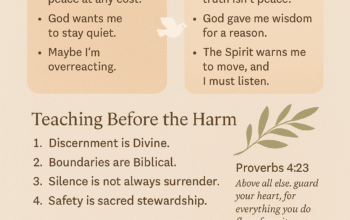
1️⃣ Church culture often confuses “niceness” with safety
In church life, we’re taught:
- be kind
- assume the best
- don’t judge
- give grace
- trust leadership
So when someone shows a lot of interest in kids, people say:
“They just have such a heart for children.”
Meanwhile, if the exact same behavior happened at a public park, most adults would feel uneasy.
Groomers use church language and church manners to disarm suspicion.
2️⃣ Predators intentionally look “helpful,” “godly,” and indispensable
Groomers rarely walk in looking creepy.
They volunteer.
They stay late.
They fill gaps.
They earn trust.
They become “the person everyone relies on.”
Churches then feel:
“We can’t imagine ministry without them.”
And because the person seems spiritually committed, people hesitate to question them — even when something feels off.
3️⃣ The theology of forgiveness gets twisted
Churches rightfully talk about:
- grace
- mercy
- redemption
But predators manipulate that.
Leaders may say things like:
“We dealt with it privately.”
“They repented.”
“Let’s not ruin their life.”
“We’re all sinners.”
So instead of drawing strong boundaries, the focus shifts to protecting the adult’s reputation, not the child’s safety.
In any other setting — a hospital, a daycare, a youth sports league — ongoing access would never be allowed.
4️⃣ Deference to authority stops people from speaking up
In many churches, questioning a leader feels like questioning God.
So parents think:
“Maybe I’m being paranoid.”
“They’ve been here for years.”
“I don’t want to cause trouble.”
“Who am I to accuse someone?”
Meanwhile, groomers are counting on exactly that silence.
In regular life, if something felt wrong at a store or neighborhood event, parents would speak up faster — because there’s no spiritual weight wrapped around it.
5️⃣ Grooming doesn’t look like abuse at first
This is the most important truth:
Grooming rarely looks like violence.
It looks like:
- extra attention
- special gifts
- private inside jokes
- special privileges
- secret texting / DMs
- gradual isolation
- slow boundary pushing
“Let’s not tell your mom — she wouldn’t understand.”
“It’s just between us — you’re mature.”
“You’re my favorite.”
Nothing dramatic at first.
Just slow conditioning.
So instead of alarm bells, people see:
“connection,”
“mentorship,”
“caring relationship.”
Until it becomes something else entirely.
6️⃣ Churches sometimes place “unity” over truth
People fear:
- division
- scandal
- bad press
- losing members
- upsetting donors
So they say things like:
“Let’s handle this quietly.”
“We don’t want gossip.”
“Satan wants to destroy our church.”
But silence has never protected a church — it has only ever protected abusers.
Healthy churches know:
Truth heals. Hiding harms.
7️⃣ Kids are taught to be polite — not safe
Many children are taught:
- respect adults
- don’t talk back
- don’t make a scene
- smile
- hug
Almost never are they told:
- You may say “no.”
- You don’t have to hug.
- Adults don’t keep secrets with kids.
- If someone scares you, tell right away.
So when something feels wrong, they freeze.
And because “it didn’t look violent,” adults don’t see the danger.
What Churches MUST Do: Talk About Grooming Openly
We break the power of grooming by dragging it into the light.
Teach leaders, parents, and youth:
- what grooming looks like
- what language groomers use
- why secrecy is always a red flag
- that “nice” does not equal “safe”
Normalize saying:
“That doesn’t feel appropriate.”
Normalize interrupting questionable behavior.
Normalize reporting concerns — even small ones.
And teach children clearly:
- You never have to keep secrets about touch or bodies.
- If something feels confusing, tell a trusted adult.
- If the first adult doesn’t listen — tell another. And another.
Kids should never feel responsible for protecting an adult’s reputation.
Their only job is to be children.
The bottom line
People get grooming wrong in church because church often assumes:
- love = safety
- faith = trust
- repentance = restored access
- leadership = unquestionable
But real love protects.
Real faith uses discernment.
Real repentance accepts permanent boundaries.
Healthy leadership welcomes accountability.